





Metropolis Council Speaker Julie Menin presides over the Council’s said assembly at Metropolis Corridor on March 26, 2026.
Picture by John McCarten/NYC Council Media Unit
The New York Metropolis Council authorized on Thursday a package deal of payments aimed toward combating hate — together with two contentious measures requiring the NYPD to develop and publicly submit plans for responding to protests close to faculties and homes of worship when there’s a danger of obstruction, harm, intimidation or interference.
The homes-of-worship measure, Intro 1-B, handed 44-5, sufficient to override a mayoral veto. An analogous invoice overlaying faculties, Intro 175-B, handed 30-19, leaving it six votes in need of a veto-proof margin and organising a call for Mayor Zohran Mamdani, who has not beforehand supported the measures outright.
Metropolis Corridor didn’t reply to requests for remark on the time of publication as to how the mayor will act on the payments. The legislative language is much like an govt order then-Mayor Eric Adams signed earlier than leaving workplace, which Mamdani nullified by way of a blanket govt order issued after changing into mayor on New Yr’s Day.
Supporters solid the laws as a public security and transparency measure, not a restriction on speech. Opponents argue it may give the NYPD an excessive amount of discretion over protest exercise and invite constitutional challenges.
Buffer zone payments wanted for ‘safe passages’
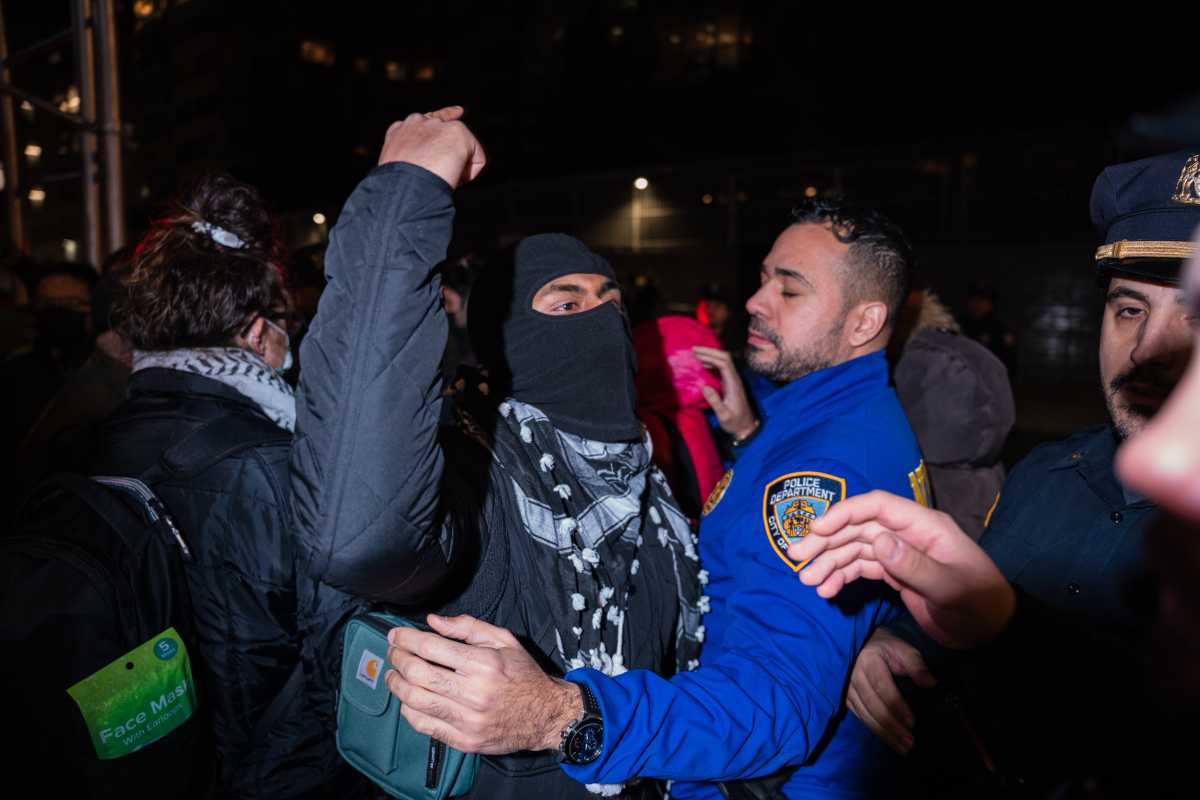 Professional Palestinian protesters rally outdoors of a synagogue, to protest a corporation that promotes Aliyah to Israel, as counter protesters collect in opposition.Picture by Yoav Ginsburg/ZUMA Press Wire
Earlier than the March 26 vote, Council Speaker Julie Menin stated the houses-of-worship invoice was meant to guard entry whereas preserving free speech, meeting and protest rights. She stated the measure would require the NYPD to create a public plan to handle the dangers of bodily obstruction, harm, intimidation, and interference, whereas additionally offering for communication with spiritual leaders, the general public, and protesters.
Bronx Council Member Eric Dinowitz, sponsor of the colleges invoice, stated his measure would create a framework for “safe passages” for college students and reply to stories from college students who felt harassed or intimidated whereas coming into faculty buildings. He stated the invoice would enhance accountability and transparency whereas defending First Modification rights.
The vote adopted weeks of revisions to the laws. In February, Menin stated the Council had softened the unique proposals by dropping a compulsory 100-foot perimeter rule and a requirement for limitations at entrances and exits. The revised payments as an alternative direct the police commissioner to provide a proposed plan inside 45 days and a remaining plan inside 90 days outlining when and the way safety perimeters could also be used.
Menin stated these modifications adopted discussions with the NYPD and have been meant to protect protest rights whereas giving police flexibility. She repeatedly described the revised laws as content-neutral and stated it created no new legal penalties.
At a press convention earlier than Thursday’s assembly, Menin stated she had spoken with Mamdani a number of occasions concerning the houses-of-worship invoice and that he had not indicated to her that he deliberate to veto it. She stated he directed her to work with the town legislation division, and that feedback from the legislation division and the NYPD have been mirrored within the present model. However she additionally stated she had not spoken with him just lately concerning the remaining amended invoice.
The laws is a part of a broader Council package deal tied to a five-point plan to fight antisemitism and different types of hate.
Why supporters say the payments are wanted
The payments have been born out of demonstrations outdoors Park East Synagogue in Manhattan and a synagogue in Kew Gardens Hills, Queens, in addition to broader political fallout from pro-Palestinian protests on faculty campuses that intensified debate over antisemitism, protest rights and public security.
Supporters of the houses-of-worship invoice included Rabbi Marc Schneier, president of the Basis for Ethnic Understanding, who praised its passage, “No one should have to be worried about protesters harassing them when entering a house of worship.”
The measures additionally drew organized opposition from civil liberties, clergy, training and pro-Palestinian advocacy teams. Earlier than the vote, the New York Civil Liberties Union rallied outdoors Metropolis Corridor with different opponents urging lawmakers to reject what they referred to as “no-speech zones.”
Critics argued the payments have been pointless as a result of present legislation already prohibits obstruction, harassment and assault, and stated the laws would develop police discretion over constitutionally protected protest. Additionally they argued the measures may disproportionately have an effect on pro-Palestinian demonstrators and different teams engaged in political advocacy.
Among the many Council members voting no was Brooklyn’s Shahana Hanif, who stated in ready remarks that the payments raised critical constitutional issues, undermined the town’s protest settlement framework and gave the NYPD an excessive amount of energy to police speech.
She additionally objected to a carveout for labor picketing, saying it may create content- or speaker-based distinctions below the legislation.
“At a time when our federal government is eroding civil liberties, New York City must model a different path—one that protects both safety and fundamental rights. It is imperative that we do not expand police discretion over when and where people can speak and organize,” Hanif stated.
