





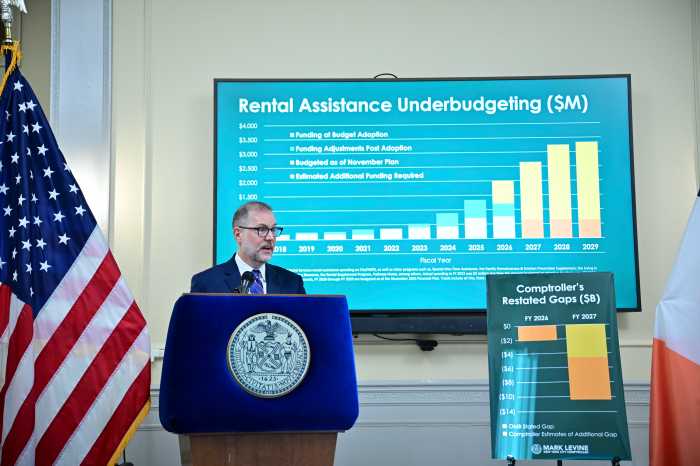
New York Metropolis is dealing with a $2.2 billion finances shortfall on this fiscal yr and a projected $10.4 billion hole the next yr, in response to a brand new evaluation launched Friday by new Comptroller Mark Levine, who blamed years of underbudgeting and reliance on one-time fixes.
Levine mentioned the gaps, the biggest town has confronted this late within the finances cycle for the reason that Nice Recession, should not the results of an financial downturn, however of spending selections made underneath the earlier mayoral administration of Eric Adams.
“This wasn’t caused by a bad economy — it’s the result of budgeting decisions from the previous administration that we must now deal with,” Levine mentioned.
The evaluation expands on monetary information launched in December and comes as town enters finances season, with the state finances due subsequent week and Mayor Zohran Mamdani’s preliminary metropolis finances anticipated in February. Levine mentioned the dimensions of the projected gaps presents “serious challenges” for town’s funds.
Regardless of some indicators of potential weak point within the labor market, Levine mentioned town’s broader financial outlook stays comparatively sturdy. Tourism, Broadway attendance, industrial leasing, and a powerful inventory market have continued to drive income progress, undercutting claims that the looming finances gaps are tied to an financial slowdown.
As an alternative, Levine pointed to projected spending ranges in FY26 that exceed anticipated revenues and a failure to completely account for recognized, recurring bills.
His workplace recognized $3.8 billion in unbudgeted prices in FY26 alone, with even bigger gaps projected in subsequent years. These prices embody rental help, extra time, homeless shelter bills, public help, particular training due course of instances on the Division of Schooling, and contributions to the Metropolitan Transportation Authority.
Comptroller Levine blames years of underbudgeting for town’s projected finances gaps.Photograph by Lloyd Mitchell
At a press convention in Decrease Manhattan on Friday, Levine mentioned his workplace’s projections considerably exceed these printed by town’s Workplace of Administration and Price range simply weeks earlier, and he warned in opposition to continued reliance on one-time finances options.
“We want the city to end the practices that got us into this mess — reliance on one-shots, and particularly this long-running practice of underestimating expenses that we know we’re going to incur,” Levine mentioned.
Levine mentioned that rising town’s economic system is among the few methods to ease future finances gaps with out resorting to cuts or different painful tradeoffs, arguing that elevated enterprise funding and job progress would generate extra income.
As Metropolis Corridor and Albany put together their respective budgets, Mayor Mamdani has proposed elevating taxes to fund main coverage initiatives and assist shut future finances gaps. Mamdani has backed growing the state’s company tax fee for giant corporations to 11.5%, up from 7.25%, matching New Jersey’s high fee, and imposing extra revenue taxes on New Yorkers incomes greater than $1 million yearly.
Gov. Kathy Hochul has dominated out elevating taxes on high-income earners on this yr’s finances, although she has beforehand left open the potential of adjustments to company revenue taxes. Hochul didn’t suggest any tax will increase in her State of the State handle this week.
“Our future depends on residents and businesses coming, staying, paying taxes, and creating jobs here,” CBC President Andrew S. Rein mentioned in an announcement. “This requires the State to focus its money and management on programs that deliver results.” The group additionally criticized the governor’s proposals for missing clear price estimates, saying the monetary impression of recent initiatives will solely grow to be clear as soon as the chief finances is launched.
Levine cautioned that coverage expansions with out sustainable funding might additional pressure town’s funds. He cited a possible enlargement of a housing voucher program — at present tied up in courtroom — which his workplace estimates might price between $6 billion and $20 billion over 5 years if applied. These prices should not mirrored within the metropolis’s present monetary plan.
Healthcare prices pose one other rising danger, Levine mentioned, confirming that town’s Well being Insurance coverage Stabilization Fund is bancrupt and carries excellent obligations that can have to be resolved by means of negotiations with municipal labor unions. Whereas retirees mustn’t fear about shedding advantages, he mentioned town should start accounting for rising healthcare prices beginning in 2027.
Earlier than leaving workplace, former Comptroller Brad Lander launched an audit discovering that the joint medical insurance fund was bancrupt and mismanaged, with roughly $3.1 billion in unpaid liabilities. The audit really helpful dissolving the fund and budgeting for medical insurance prices yearly.
 Photograph by Lloyd Mitchell
Regardless of the awful projections, Levine mentioned town doesn’t have to abandon bold objectives, although he cautioned that main initiatives might have to be phased in over a number of years and grounded in additional clear accounting.
“This does not mean we still cannot act boldly,” Levine mentioned.
Levine framed Friday’s report as a gap step in what can be months of negotiations throughout metropolis and state authorities.
“In February, Mayor Mamdani and his administration will have the difficult responsibility of producing a balanced preliminary budget,” Levine mentioned. “I’m committed to working alongside Mayor Mamdani and leadership in Albany to ensure the city can make good on its financial obligations and deliver a balanced budget this year and next.”
Individually, Levine was additionally requested about selections made underneath his predecessor, together with town sustaining pension fund investments in Palantir Applied sciences, whose software program has been utilized by federal immigration authorities and Israeli weapons producers.
In response, Levine emphasised the comptroller’s position as a fiduciary overseeing one of many largest public pension methods on the earth, saying his workplace favors shareholder engagement over divestment when addressing controversial company practices. He famous that town’s pension portfolios collectively exceed $300 billion and embody a big selection of publicly traded shares, together with corporations “that I and others find have objectionable practices.”
“We are aggressive shareholders,” Levine mentioned. “We own. We have a vote for the board of directors, and we have the power to engage in shareholder activism.”
Levine mentioned his workplace is getting ready its shareholder activism agenda for 2026 and indicated that considerations about federal immigration enforcement would issue into that work.
