





Monday, March 2, marked the 61st day of Zohran Mamdani’s time period as mayor. New York News is following Mamdani round his first 100 days in workplace as we intently observe his progress on fulfilling marketing campaign guarantees, appointing key leaders to authorities posts, and managing the town’s funds. Right here’s a abstract of what the mayor did as we speak.
With sturdy political backing and $1.2 billion in new state funding, Mayor Zohran Mamdani’s common baby care effort is accelerating, however a Metropolis Council listening to Monday revealed that key operational programs, from allowing information to workforce planning, are nonetheless being constructed.
The primary-ever assembly of the Council’s Subcommittee on Early Childhood Training, chaired by Council Member Jennifer Gutiérrez, was designed to chart “The Path to Universal Child Care.” As a substitute, it additionally grew to become an in depth examination of how prepared the town is to ship on that promise.
“Our vision for universal child care is a system in which every family has access to free, high quality, culturally responsive care and education for all children under five, with care offered in a range of settings and delivered by caregivers and educators who are respected and fairly complicated,” mentioned Emmy Liss, govt director of the Mayor’s Workplace of Youngster Care and Early Childhood Training. “Successfully implementing this vision will have a profound impact on our city.”
Liss outlined the Mamdani administration’s plan to broaden 3-Ok, stabilize the kid care voucher system, and launch a brand new free “2-care” program for two-year-olds starting in fall 2026. The primary 12 months would serve roughly 2,000 kids, increasing by 10,000 seats the next 12 months.
By the top of Mamdani’s first time period, Liss mentioned, “we will provide access to every two-year-old in the city.”
Simone Hawkins, deputy chancellor for early childhood schooling, informed council members that the town additionally plans to broaden its College Day Plus pilot program, which presents free pre-kindergarten till 6 p.m. This system at the moment operates in 85 websites with 2,855 kids enrolled, and officers hope to extend enrollment to 4,700.
She added that the town can also be consulting with suppliers and households on the 2K program, exploring each full-day, full-year and conventional school-day choices to higher match supplier capability and household wants.
Council Speaker Julie Menin, who created the brand new physique, framed the hassle as each financial and social coverage that the town “cannot afford to wait even longer.”
“Our economy requires universal child care,” mentioned Menin.
She cited information exhibiting that “approximately 300,000 parents left the workforce, mainly mothers, because they could not afford childcare,” including that the loss quantities to “around $2.2 billion a year in lost economic output.”
Council Speaker Menin, who created the Subcommittee on Early Childhood Training, questions metropolis officers MondayPhoto by Emil Cohen/NYC Council Media Unit
However as lawmakers expressed assist for the purpose, they repeatedly pressed Mamdani administration officers on whether or not the town’s programs — from information assortment and allowing to workforce recruitment and interagency coordination — are ready for growth.
Menin opened her questioning by asking concerning the standing of the Youngster Care Advisory Board created below a 2022 native legislation. “Can you share, is there a date for the board to meet? What is now the composition of the board? Has it changed at all?” she requested.
Liss mentioned the workplace has been assembly informally with suppliers and advocates and intends to formalize the board. She added that the administration would work with the Council to make sure it’s “meeting the requirements of the bill.”
Menin famous that the earlier administration “was clearly, as I mentioned, not in compliance at all with these bills,” signaling that lawmakers anticipate nearer adherence shifting ahead.A number of council members zeroed in on the allowing course of, which requires approvals from a number of companies, together with the Fireplace Division, Division of Buildings, and Division of Well being and Psychological Hygiene.
“Providers are frequently reporting long wait times for such a literally simple task,” Menin mentioned. “What are the administration’s plans to cut through this bureaucracy?”
Liss responded that the administration is “taking a really close look at the permitting process” in coordination with DOHMH and different companies and promised “an update on this in the next couple of weeks.”
When requested what number of suppliers have utilized for permits or renewals for the reason that begin of the 12 months — and what number of functions stay excellent — Liss acknowledged, “we’ll get that number from the Department of Health and get back to you.”
Menin referred to as them “very rudimentary questions,” and that gaining access to fundamental operational information is crucial for the following listening to of the brand new physique.
Council Member Lincoln Restler argued that dependable public information can be important to making sure common entry, advocating for the passage of Intro. 631, which might require the DOE to report complete data on 3-Ok and pre Ok functions, seat availability and vacancies, in addition to data on staffing and outreach efforts.
“Under the previous administration, we got very, very little information on 3k,” he mentioned, including that detailed breakdowns of seat vacancies had been usually delivered “the morning of the preliminary budget hearing.”
“It all starts with the data,” Restler mentioned. “Once we have really good, consistent data that’s being provided in a timely manner, that’s available to the council, that’s available to the public, we can all put our best brains together to make sure that every child in New York City who needs an early childhood seat is getting it.”
Council members additionally raised considerations about whether or not the town has sufficient educators and early intervention suppliers to assist growth.
Hawkins mentioned the division has “an early intervention transition team that works closely with DOHMH to support families as they transition from early intervention.”
However when pressed about recruitment methods for therapists and repair coordinators, Hawkins mentioned, “We can’t speak to that particularly … because early intervention is not within the sphere of control for New York City public schools,” and pledged to observe up.
Liss famous earlier within the listening to that it’ll take a variety of stakeholders to ship all features of the common childcare plan, acknowledging the necessity to considerably broaden the variety of educated professionals working in childcare who’ve thus far “been underpaid and under-respected for too long.”
Gutiérrez requested Lis to explain the staffing and position of the Mayor’s Workplace of Youngster Care.
Lis mentioned the workplace at the moment has “six full-time members” and plans so as to add workers by way of the finances course of.
The workplace holds common interagency conferences with the Departments of Training, Well being and Psychological Hygiene, and Administration for Kids’s Companies. “We’re hanging out a lot,” Liss mentioned, describing the frequency of coordination conferences.
All through the listening to, the tone was largely collaborative. Council members repeatedly praised the administration’s dedication, and Lis informed lawmakers, “We would not be here today without your efforts.” Nonetheless, the oversight session underscored that whereas political momentum is powerful and funding commitments are in place, the mechanics of implementation stay a piece in progress.
As Gutiérrez famous, constructing a common system means navigating “different agencies,” “different funding streams,” “different rules,” and “different workforce structure.”
“When everything gets lumped together, it’s hard to see what’s really broken. So instead of treating childcare like one giant problem, we’re going to take it piece by piece,” mentioned Gutiérrez.
Appointments: Small enterprise czar
Mamdani, who stored a comparatively low profile on Monday, appointed Kenny Minaya to steer the Division of Small Enterprise Companies, inserting a veteran metropolis official with a background in shopper safety and tenant advocacy answerable for an company central to his affordability agenda.
Minaya most not too long ago served as first deputy commissioner of the Division of Shopper and Employee Safety, the place he oversaw operations and funds. He joined the company in 2016 as deputy chief of workers.
Earlier than coming into metropolis authorities, Minaya labored at Catholic Migration Companies and Make the Highway New York, representing immigrant tenants in housing disputes in Brooklyn and Queens.
In an interview with New York Focus, Minaya mentioned the administration intends to tie small-business coverage extra intently to what Mayor Mamdani has framed as an financial justice agenda. The mayor beforehand signed an govt order directing metropolis companies to evaluate and cut back charges and civil penalties imposed on small companies, which Metropolis Corridor says should navigate greater than 6,000 rules and guidelines.
Minaya informed the outlet that the company will play a key position in implementing that order, together with efforts to streamline allowing and fantastic constructions. He will even oversee the implementation of not too long ago accepted road merchandising reforms, together with increasing vendor licenses and creating a brand new Division of Avenue Vendor Help.
The Division of Small Enterprise Companies supplies coaching, monetary and technical help to companies and oversees workforce growth and business hall packages throughout the 5 boroughs.
“Under Mayor Mamdani, we are ushering in a new era for small businesses in our city. I am deeply thankful for the Mayor’s trust and confidence and am proud to take on this responsibility,” mentioned Minaya in an announcement. “As the son of immigrant small business owners, I know firsthand the challenges that our entrepreneurs face. I am excited to partner with the dedicated public servants at SBS — whose work every day supports businesses in every neighborhood — and to bring both my experience in City government and my lived experience to this role as we work side-by-side with small business owners in all five boroughs.”
Price range: Opposition grows to property tax hike menace
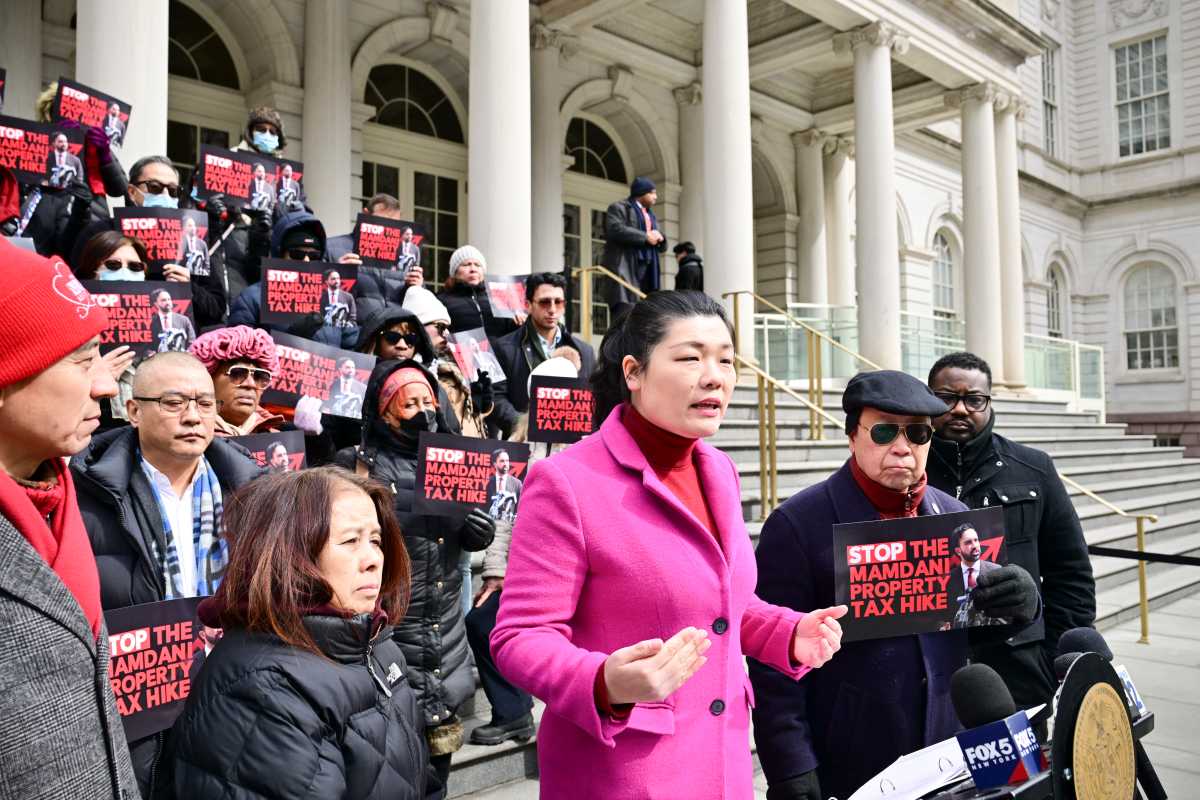 Council Member Susan Zhuang leads a rally with owners and property homeowners to object to Mayor Mamdani’s property tax hike.Photograph by Lloyd Mitchell
Opposition to Mayor Mamdani’s menace to boost property taxes by almost 10% if Albany doesn’t approve increased taxes on the rich and high firms got here to Metropolis Corridor on Monday.
Council Member Susan Zhuang led a cadre of opponents from working-class neighborhoods calling on the mayor to take away a property tax enhance from consideration and pursue a finances resolution that doesn’t depend on working households, saying the mentioned the proposed hike would squeeze owners already battling rising prices and will drive up rents for tenants.
“Homeowners in my district are already juggling mortgages, utilities, child care, and rising grocery bills,” mentioned Zhuang. “A nearly 10% property tax hike is unfair and unacceptable. And when property taxes go up, rents go up right behind them. Working families shouldn’t be the fallback plan in a political standoff. We need a budget that protects New Yorkers, not one that burdens them with higher bills.”
Oster Bryan of the St. Albans Civic Enchancment Affiliation mentioned the proposed enhance would hit Black and brown communities disproportionately. “When housing costs rise, spending drops, opportunities shrink, and neighborhoods feel it,” Bryan mentioned. “A near-10% property tax increase would ripple across our communities and hit renters just as hard as homeowners. We need stability and smart fiscal management, not policies that add more pressure.”
The mayor, for his half, has repeatably described the property tax hike as a “last resort” to shut a multibillion‑greenback finances hole, saying his most well-liked choice is to tax the rich and firms as a substitute.
