


As Mayor Zohran Mamdani reaches his one hundredth day in workplace this Friday, his administration’s engagement with the town’s numerous spiritual teams has been a curious subject of curiosity for a lot of New Yorkers.
New York News got down to decide whether or not the Huge Apple’s first Muslim American mayor has develop into the “mayor for all New Yorkers” he vowed to be each on the marketing campaign path final 12 months and in his inauguration deal with New Yr’s Day, or if he’s nonetheless a piece in progress.
Main the nation’s largest metropolis, house to almost each main world religion, Mamdani has at many instances promoted interfaith dialogue and collaboration. He has met one-on-one with Jewish and different religion leaders, attended Christian church providers and took part in cultural occasions throughout the spiritual spectrum.
However a wholesome handful of notable, headline-making occasions stood out to New Yorkers, elevating questions on how effectively he helps religion leaders and followers just some months into his time period.
Mamdani and the brand new Catholic archbishop
Barely a month into his mayoralship, Mamdani drew the ire of lots of the metropolis’s Catholics when he was noticeably absent from the set up of Ronald Hicks as Archbishop of New York at St. Patrick’s Cathedral on Feb. 6, changing Cardinal Timothy Dolan.
The mayor was invited, however declined to attend; he attended an interfaith breakfast his workplace organized that very same morning, for which Hicks was not current.
Greater than 2.8 million Catholics stay within the Archdiocese of New York, the place Hicks now presides; the archdiocese contains Manhattan, the Bronx and Staten Island. One other 1.3 million Catholics are within the neighboring Diocese of Brooklyn, led by Bishop Robert Brennan and overlaying Brooklyn and Queens.
Catholics throughout the town took umbrage with the mayor’s absence from Hicks’ set up Mass, prompting many to name him out for ignoring the extremely important spiritual occasion.
“He could easily have been there,” Invoice Donohue, president of the Catholic League, mentioned in an announcement. “Instead, he attended to business as usual.”
However, the connection between the mayor and the brand new archbishop seems strong. Mamdani has had a number of personal conferences and cellphone calls with Archbishop Hicks to this point this 12 months and attended mass at St. Patrick’s Cathedral on St. Patrick’s Day.
“Since my installation, I’ve had the opportunity to speak with him on the phone, be at breakfast with him at an event, and also speak with him personally, just one-on-one. So, I’m getting to know him, and it’s been good so far, and I was just glad that he, and so many people, were here today,” the archbishop mentioned at St. Patrick’s Cathedral about assembly with the mayor.
Mamdani shakes arms with Archbishop Ronald Hicks exterior St. Patrick’s Cathedral throughout a parade pit stopPhoto by Dean Moses
But Mamdani once more appeared to slight Christians on Good Friday — the holy day marking Jesus’ crucifixion — by omitting any point out of Jesus Christ on his X submit.
“All those words to avoid mentioning Jesus Christ,” one in all many individuals who commented on the submit wrote. “Good Friday is about remembering the suffering of Christ.”
One other individual wrote, “You forgot to mention Jesus Christ, Mr. Mayor.”
On Easter Sunday, nevertheless, the mayor tweeted on X Easter greetings and famous that the day marked “the resurrection of Jesus Christ and the victory of hope over despair and faith over fear.”
Coping with antisemitism
From the start, Mamdani’s relationship with the Jewish group has been underneath a microscope, largely due to his outspoken assist of Palestinians and former criticism of Israel. He took flak for saying he supported Israel’s proper to exist as a “state of equal rights” slightly than as a Jewish state, and for refusing to outright condemn the usage of inflammatory phrases comparable to “globalize the intifada,” which he would say is language that he wouldn’t use himself.
Such terminology has helped result in an increase in antisemitism lately. The variety of bias incidents investigated by the NYPD’s Hate Crimes Job Drive skyrocketed by 152% (58 vs. 23) in January, in comparison with the identical month in 2025, in response to NYPD statistics.
Mamdani has usually condemned acts of hate towards Jewish New Yorkers. In January, as an illustration, he raced to Chabad Lubavitch headquarters in Brooklyn after a person drove his automotive by the entrance door deliberately in what police categorized as a hate crime. The mayor met with Chabad members and publicly condemned the crime, saying, “Any threat to a Jewish institution or place of worship must be taken seriously. Antisemitism has no place in our city.”
Such condemnation has not dispelled considerations in regards to the mayor’s management for some New Yorkers, like Aron Boxer, a Jewish New Yorker who lives in Manhattan. He instructed New York News that he believes Mamdani talks greater than he takes motion.
“He has said the right things, that he supports the Jewish people, says he’s not an antisemite. But sometimes he’s silent, and that’s not leadership,” mentioned Boxer, CEO of Diversified Training Companies, a tutoring and training firm.
 A swastika — a logo of hate — was scrawled on the aspect of a vacant storefront in Brooklyn on March 13, 2026.JoAnne Wasserman
Boxer added that he has spoken to many Jewish New Yorkers who don’t really feel protected underneath his management.
“As a Jewish New Yorker, we don’t need symbolism,” he mentioned. “We need to feel protected. You can’t claim to stand with the community while we’re increasingly looking over our shoulders.”
He needs the mayor to stay as much as his “mayor of all New Yorkers” slogan and work for everybody, not simply the communities that voted for him.
Rabbi Mark Wildes, of the Manhattan Jewish Expertise, held again no punches when he known as Mamdani’s administration a “disaster.” He singled out final 12 months’s notorious Park East Synagogue incident, which occurred after the mayor’s election win on Nov. 19. A whole lot of protestors, many from the Palestinian Meeting for Liberation NY/NJ, descended on the Manhattan home of worship, protesting a gaggle that assists Jewish immigration to Israel.
“He did not give any sense of safety to parishioners, to Jewish people trying to attend the religious service in the synagogue,” the rabbi instructed New York News.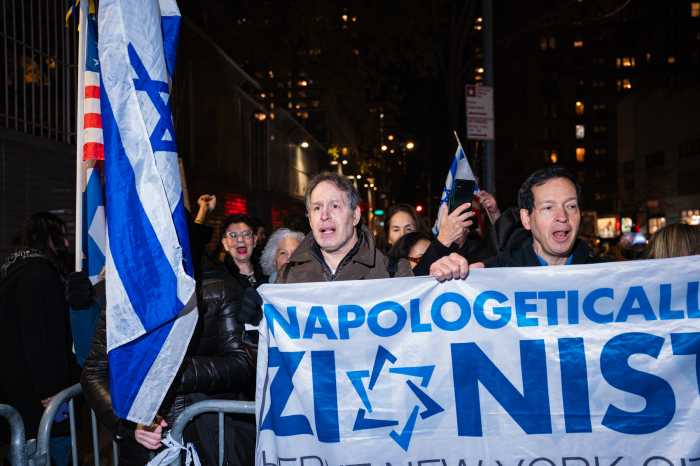 Jewish counter-protesters collect in entrance of Park East Synagogue as police preserve demonstrators separated throughout a protest towards a Nefesh B’Nefesh occasion on Nov. 19Photo by Yoav Ginsburg/ZUM
The NYC Council handed laws on March 26 to create buffer zones for protests exterior homes of worship with out impeding free speech. Nonetheless, some critics of the proposal, together with Wildes, are skeptical about how efficient the brand new legislation could be. The plan requires the NYPD to train discretion in protest zones and to develop a plan of motion to deal with frequent protest points, together with obstruction, harm and intimidation.
“We wanted an objective rule and law that if you’re protesting in front of a house of worship, whether it’s a mosque, whether it’s a church, whether it’s a synagogue, you need to stand 100 feet away,” Wildes mentioned.
The 100-foot rule is just like state laws launched final 12 months following the Park East Synagogue incident, which known as for a 25-foot buffer zone round homes of worship and different establishments, limiting protests that straight impede entry or create a hostile setting for anybody getting into or exiting the constructing.
Mamdani has but to signal the town council’s protest laws, and cited considerations about its constitutionality.
Mayor continues to evangelise a metropolis of ‘all faiths’
A spokesperson for Mamdani instructed New York News the mayor is dedicated to defending each spiritual freedom and security for the town.
“New Yorkers of all faiths deserve to be safe and free to practice their faith in the city they call home,” he mentioned. “The mayor has engaged both privately and publicly with New Yorkers of all faiths, and he will continue to defend the religious freedom and dignity of all New Yorkers.”
In the meantime, the mayor has been extremely seen at spiritual celebrations, most just lately showing on the annual Phagwah Parade in Richmond Hill on March 29.
The parade, which honors the Hindu pageant of Holi — and coincided this 12 months with the Christian vacation of Palm Sunday — was a vibrant show.
Lined within the conventional colourful powders that mark the festivity of spring, Mamdani was photographed smiling and interesting with spectators alongside the parade route.
On March 31, he additionally participated in an early Seder service at Metropolis Vineyard celebrating Passover, the place he spoke in regards to the frequent virtues shared in celebrating the Jewish vacation of liberation from enslavement. He spoke of the customs directing believers to “share our plenty,” comparable to distributing 4 cups of wine to every individual.
“These directives extend beyond the Seder table. Let us build a city where every New Yorker is accorded the dignity of rest, where even the poorest among us know their cup will be filled,” he instructed the gang. “And we all know that if they seek shelter, they will find it. If they are hungry, they will be fed.”
 Mayor Zohran Mamdani at a Holi celebration.Photograph by Lloyd Mitchell
On Easter Sunday, which was April 5, he attended Christian church providers and delivered remarks on the Bronx Bethany Church of the Nazarene the Ebenezer City Ministry Middle in Brooklyn.
Nevertheless it was throughout the Islamic holy month of Ramadan that Mamdani, as the town’s first Muslim mayor, made his most public celebrations of religion.
In keeping with CNN, the mayor attended 17 iftars in NYC, that are night meals to interrupt the month-long Ramadan quick spanning Feb. 17 to March 19 this 12 months. He prayed with taxi drivers throughout a Ramadan dinner, held an iftar for NYC staff and likewise visited Rikers Island for the event, the place he broke quick with each incarcerated Muslims and Muslim corrections employees.
Mamdani embraced and publicly celebrated Ramadan not like any of his predecessors, and he appeared to make use of his place as a window for individuals to raised perceive a religion shared by as many as 1 million New Yorkers, in response to many inhabitants estimates.
“I know that for me to stand in front of you, it took years, decades, generations of work that was often unseen and unrecognized,” he instructed metropolis staff at a March 12 Iftar. “Blazing a trail, blazing a path, knowing that it may never be enjoyed by those who blaze it, but in fact by those who come after. And I have been reminded of that legacy every day this Ramadan.”
Mamdani’s ongoing engagement with NYC’s religion communities will proceed to be a measure of his dedication to New Yorkers, particularly as the town addresses advanced problems with security, spiritual freedom, freedom of speech and tolerance.


