


Roughly eight weeks into his administration, Mayor Zohran Mamdani is being pressed by privateness advocates to dismantle main elements of the NYPD’s surveillance infrastructure — arguing that he can use his mayoral powers to take action.
A brand new report launched Thursday by the Surveillance Expertise Oversight Undertaking (S.T.O.P.) lays out eight steps the mayor, a longtime critic of police surveillance, may take with out ready for the Metropolis Council or state lawmakers.
The Brooklyn-based civil rights nonprofit, which has been preventing discriminatory surveillance and defending the privateness and civil rights of New Yorkers via analysis, litigation, and coverage advocacy since its launch in 2019, framed the report as a roadmap for finishing up Mamdani’s marketing campaign guarantees.
Titled “Dear Mamdani: Dismantle NYC’s Surveillance State,” the report urges him to dam Immigration and Customs Enforcement (ICE) from accessing metropolis knowledge, abolish police databases that disproportionately goal Black and Latino New Yorkers, floor police drones, and ban facial recognition know-how outright.
“It takes time to make change, to get settled into office,” Eleni Manis, S.T.O.P.’s analysis director, informed New York News of the nascent administration. However with the Trump administration increasing deportation efforts specifically, she mentioned, “there are steps he can take right now in virtue of the powers vested in his office to act, and so we wanted to put those on his desk.”
Metropolis Corridor had not responded to a request for remark as of publication. S.T.O.P. mentioned it offered the administration with an advance copy of the report.
Advocates need Mamdani to direct Tisch to alter surveillance
Beneath the Metropolis Constitution, the mayor oversees the NYPD via the police commissioner, Jessica Tisch, a place the report and Manis argue is ample to make sweeping coverage modifications.
Tisch, a long-time Metropolis Corridor technocrat and public servant, has risen via a sequence of high-profile authorities roles to grow to be commissioner of the NYPD, the place she oversaw a drop in crime charges throughout her first 12 months. She initially joined the power in 2008 as a civilian analyst within the NYPD Counterterrorism Bureau, finally changing into deputy commissioner for data know-how and later main town’s tech company and the Division of Sanitation.
Throughout her tenure in NYPD know-how management, Tisch performed a central position in constructing the Area Consciousness System, the huge surveillance community that collects knowledge from tens of hundreds of cameras, license plate readers, and different sensors — a software praised for crime preventing by supporters and criticized as a mass surveillance equipment by civil liberties advocates like S.T.O.P.
Having been appointed commissioner by Eric Adams, her retention by Mamdani has been a intently watched partnership, outlined by contrasting views on policing, significantly in terms of surveillance, however united by a shared deal with public security.
Since Monday, nonetheless, an obvious rift between the 2 surfaced over whether or not a snowball struggle in Washington Sq. Park, throughout which responding officers had been pelted and a few reportedly injured, needs to be investigated as a prison matter. Tisch has referred to as for an investigation; Mamdani has said his perception that the incident was not prison.
The mayor insisted Wednesday that their working relationship stays productive, regardless of the distinction of opinion.
Police Commissioner Jessica Tisch stood alongside Mayor Zohran Mamdani and Gov. Kathy Hochul at One Police Plaza Tuesday, Jan. 6 and reported a report 12 months for the NYPD in 2025 — one which noticed the fewest variety of shootings and victims since 2018, breaking data.Picture by Dean Moses
Blocking ICE entry to metropolis surveillance knowledge, ending jail name monitoring
On the high of S.T.O.P.’s listing is immigration enforcement.
Mamdani not too long ago signed an government order to strengthen sanctuary protections. However Manis mentioned extra is required to make sure that town’s huge surveillance programs can’t be utilized in civil immigration enforcement.
“It is not transparent what ICE could have access to, and I don’t want to speculate,” she mentioned. “But we know that across the country, ICE has accessed license plate reader data. It has accessed other sources of location data for cities’ residents. It has accessed gang databases.”
The report calls on the mayor to: audit whether or not ICE has direct or oblique entry to license plate reader knowledge; assessment data-sharing via federal activity forces; look at whether or not distributors serving each town and ICE create backdoor entry; and scrutinize the Division of Corrections’ collaboration with the company.
The urgency, Manis argued, stems from the size of town’s surveillance infrastructure — tens of hundreds of cameras and a whole bunch of license plate readers feeding into the NYPD’s Area Consciousness System.
A latest probe by town’s Division of Investigation (DOI) discovered {that a} single NYPD officer violated metropolis restrictions on aiding with federal civil immigration enforcement by putting automated alerts on people sought by immigration authorities again in 2014.
Whereas the broader NYPD usually complies with native sanctuary legal guidelines, the DOI report discovered a number of gaps that go away the division weak to improper data sharing. The DOI issued seven suggestions to enhance documentation, strengthen coaching, consolidate overlapping insurance policies, and guarantee clearer procedures — all of which the NYPD accepted.
When incidents of improper knowledge sharing floor, she mentioned they shouldn’t be dismissed as remoted.
“These glitches and one-offs happen over and over and over again,” she mentioned. “They’re completely predictable when you have unregulated or untransparent databases.”
Earlier this month, Mayor Mamdani signed an government order geared toward strengthening town’s limits on cooperation with federal immigration enforcement.
The directive reaffirms the prohibition on Immigration and Customs Enforcement brokers getting into metropolis property with no judicial warrant, orders businesses to audit their interactions with federal immigration authorities, and establishes a brand new interagency response committee for main enforcement actions.
Manis mentioned that whereas these steps are welcome, the report revealed Thursday supplies a strategy to improve town’s privateness protections to keep away from New Yorkers’ personal knowledge from being unlawfully accessed.
“These are concrete steps the mayor can take to make good on the commitment in that executive order,” she mentioned.
The report additionally urges the mayor to finish what it describes as indiscriminate recording of jail telephone calls.
The Division of Correction’s contract with Securus, valued at $12.39 million for 2 years of service, data and screens just about all calls from metropolis jails. In keeping with the report, which incorporates attorney-client communications and calls involving individuals representing themselves in courtroom. The personal firm has, up to now, confronted allegations in different jurisdictions of illegal surveillance and knowledge safety failures.
S.T.O.P. argues the mayor may direct the corrections commissioner to restrict monitoring to conditions supported by individualized suspicion and strictly implement do-not-record lists defending authorized privilege.
Police databases, facial recognition, and dragnet warrants
A number of of essentially the most sweeping suggestions within the report goal NYPD databases.
The report requires dismantling the Felony Group Database (generally often called the gang database), the Gun Recidivist Investigation Program (GRIP) listing, and the NYPD’s Suspect Index, an inside DNA database.
In keeping with the report, Black and Latino New Yorkers make up 98% of the gang database and 98.8% of the GRIP listing. Simply 258 crimes in 2025 had been dedicated “on behalf of gangs,” the report states, whereas 8,563 New Yorkers had been marked as gang members that 12 months.
Manis mentioned she doesn’t query Mamdani’s beforehand said opposition to the gang database. “The question is whether he will stick to his guns,” she mentioned.
In January, at his first press convention together with his police commissioner, the mayor remained silent whereas Tisch mentioned the database was important to preventing gun violence and credited it with serving to legislation enforcement sort out quite a few gangs. A federal lawsuit over its use can be ongoing.
The Suspect Index, in the meantime, shops DNA from tens of hundreds of individuals — many by no means convicted of crimes — and operates individually from the state’s licensed DNA databank. The report describes it as unlawful and unregulated and cites lawsuits in search of to close it down.
“These aren’t glitches,” the report states of wrongful arrests tied to DNA errors. “They are predictable consequences of an unregulated database operating without oversight or accountability.”
S.T.O.P. additionally requires prohibiting police use of facial recognition know-how.
NYPD spent $2.28 million on its most up-to-date DataWorks facial recognition contract, based on the report, together with different expenditures. The group argues the know-how is biased and vulnerable to error, pointing to documented wrongful arrests.
“I’d like to see the evidence that these tools do, in fact, improve public safety,” Manis mentioned. “As we understand them, they endanger New Yorkers.”
The report additional urges the mayor to bar the division from in search of so-called dragnet warrants — together with geofence warrants and cell tower dumps — that compel tech corporations to determine all gadgets or customers inside a particular time window close to a location.
Grounding drones and proscribing social media surveillance
Drones have grow to be one of the seen symbols of expanded surveillance. The NYPD’s Unmanned Plane System program began in 2018 and expanded quickly below the prior Adams administration. Throughout Adams period, the NYP more and more relied upon drones for numerous functions — from trying to find misplaced swimmers on town’s seashores; to catching subway surfers; to monitoring protests; and to finding alleged criminals.
A 2024 DOI report targeted on the NYPD’s compliance with the Public Oversight of Surveillance Expertise (POST) Act, which was enacted in 2020 to police the NYPD’s surveillance efforts in each patrolling NYC and responding to incidents, discovered that whereas the NYPD has stepped up its drone utilization in recent times, it has performed so with out following correct supervision protocol or its outlined chain of command.
NYPD now deploys drones greater than 1,000 instances per thirty days, based on the report. Extra drones price $2.6 million in 2024 alone, and the division has reported greater than 60 crashes.
Drones had been pitched as emergency instruments, Manis mentioned, however at the moment are routinely used at protests and neighborhood occasions.
“We just simply have no idea when and where we’re being filmed,” she mentioned. “It’s not clear that drones are boosting public safety, but it is clear that they’re stripping away whatever privacy New Yorkers thought they had.”
The report requires ending routine drone patrols, prohibiting deployment at protests and delicate areas, shortening footage retention intervals, and barring the sharing of drone footage with prosecutors.
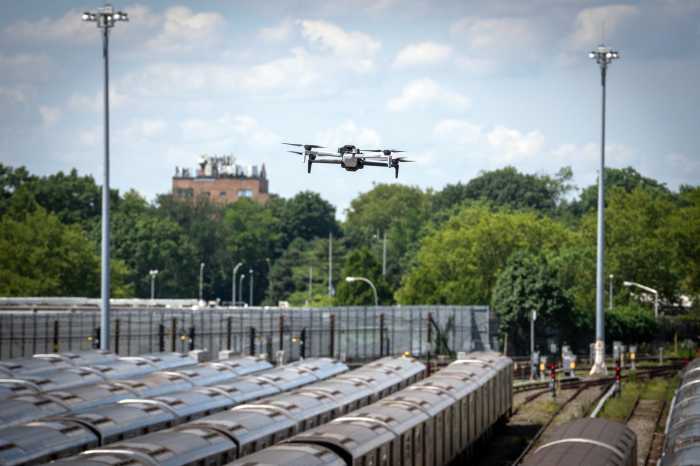 An NYPD drone hovers above subway trains in Queens throughout an indication on Monday, July 21, showcasing the division’s use of the know-how to forestall subway browsing.Picture by Ed Reed/Mayoral Images Workplace
On social media, S.T.O.P. urges stricter enforcement of the Handschu Tips — which restrict police monitoring of lawful political exercise — and requires ending the usage of pretend police accounts and rejecting contracts for social media monitoring instruments. NYPD has spent roughly $10.6 million on one such platform, Voyager, based on the report.
In 2023, as an Meeting Member, Mamdani coauthored an opinion piece for Metropolis & State advocating for state laws to forestall police from utilizing pretend social media accounts.
All through the report, S.T.O.P. emphasizes that many of those steps require no new laws.
“This is just our first foray into working with the administration to push them to do what Mamdani said he would do,” Manis mentioned.
She framed the report as an invite fairly than a rebuke.
“He has told us that he rejects facial recognition, that he rejects the NYPD’s use of fake social media profiles to dupe kids,” she mentioned. “He wants to do this. We want to work with him.”
For now, Manis mentioned, the group is concentrated on urgent the mayor to make use of the authority he already holds. “Our report walks the mayor through the steps that are entirely in his power to take right now,” she mentioned.
Manis beforehand labored on know-how insurance policies on the NYC Mayor’s Workplace of the Chief Expertise Officer and the NYC Mayor’s Workplace of Operations says her earlier work in metropolis authorities has helped her recognize that may be onerous to make change however that the mayor is uniquely positioned to realize his priorities, and if he prioritizes dismantling New York Metropolis’s surveillance equipment, “he can get it done.”


