


DOHMH Appearing Commissioner and Chief Medical Officer Michelle Morse addresses the group at Wyckoff Heights Medical Heart.
Picture by Patrick Stachniak
The opioid disaster within the U.S. that got here to gentle over a decade in the past has destroyed many lives, and New York has been aiding these affected with the Relay program, launched in 2017. On Feb. 11, Division of Well being and Psychological Hygiene (DOHMH) Appearing Commissioner Michelle Morse held a press convention at Wyckoff Heights Medical Heart with senior employees to announce their latest collaborative measures to broaden this system to the hospital and deal with these suspected of drug abuse in the long run by offering assets for restoration.
“Relay is a critical part of a larger network of care across New York City and we’ve been consistently expanding our efforts in overdose prevention and harm reduction,” Morse stated. “It’s a very humbling experience to be a part of this expansion because we have come a long way in caring for New Yorkers who use substances, and we cannot stop now, even though the curve is changing and bending.”
The Relay program connects sufferers that physicians consider to be affected by overdose or drug abuse to a wellness advocate from the DOHMH and got here to Wyckoff Heights in October of final 12 months. Sufferers are met with the advocate to supply help and are supplied a “wellness bag” that incorporates a masks, socks, hygiene necessities and Narcan, in addition to different assets for the subsequent 90 days, the interval with the best charge of relapses. To this point, 1,700 individuals throughout the Metropolis have been supplied this system when admitted to an emergency division and 94% of them have accepted.
In line with the DOHMH, overdose deaths declined considerably in 2024, and is the primary drop in quantity for Black and Latino New Yorkers, who make up 84% of Wyckoff Heights’ sufferers, since 2018. Vali joined the DOHMH in 2021, the 12 months OnPoint opened the primary publicly acknowledged overdose prevention heart, which marked the start of a 28% decline in overdose deaths over the subsequent 5 years.
“We are extremely grateful to partner with the New York City Department of Health and Mental Hygiene to implement the ED Relay program and support our patients and our communities that are greatly affected by the opioid overdoses,” stated Wyckoff Heights President and CEO Vali Gache. “The Relay program allows us to improve health equity in this community by creating access to these services in real time and at the patient’s bedside.”
Now carried out for simply six months, Gache says information particular to Wyckoff Heights won’t be out there till this October. Relay is funded by the Opioid Settlement Fund, with the DOHMH allocating $41 million to it and different hurt reduction-related providers, comparable to OnPoint’s overdose prevention facilities.
These advocates reside all around the metropolis and could be at any hospital in lower than an hour. Their job is to be a impartial third-party, separate from the hospital, to supply emotional help by means of lived experiences and educate sufferers on the completely different assets that may assist them of their restoration. In line with Dr. Lynn Manganiello, ED champion for Relay at Wyckoff Heights, the advocates present the non-public care sufferers want, permitting medical doctors to deal with others when the emergency room turns into crowded.
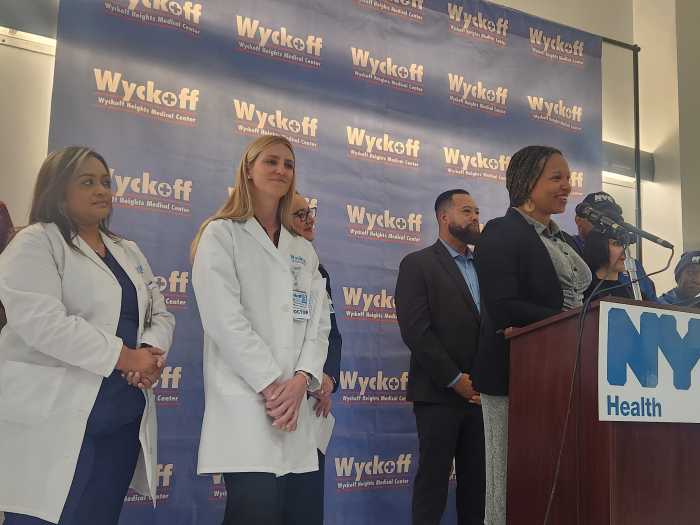 Dr. Lynn Manganiello stand beside Morse earlier than talking. Picture by Patrick Stachniak
“When it’s a very busy emergency department, I don’t have a ton of time to spend with the patient myself, so it’s amazing to have them be able to come and connect with the patient and offer them a lot more resources, support and assistance,” Manganiello stated.
Alan D., a Relay peer wellness advocate, spoke on his personal expertise with drug dependancy and his private path to wellness. Dorville expressed {that a} “cookie-cutter approach” to restoration doesn’t work for sufferers, and the advocates work with every particular person to greatest decide what may assist them.
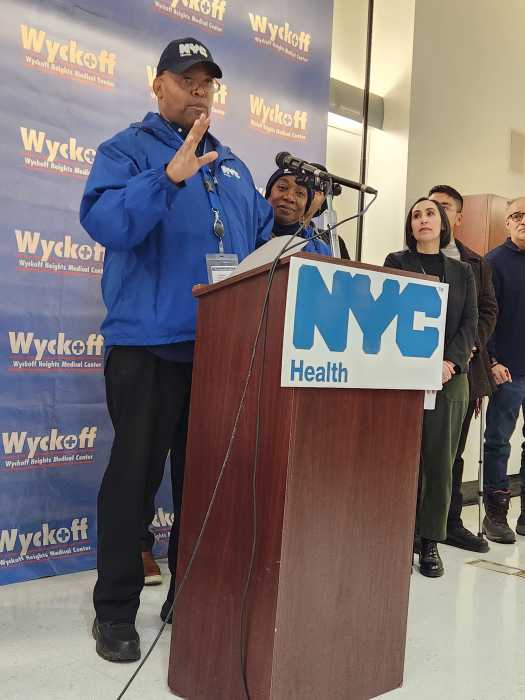 Alan D. speaks on his private expertise as an advocate for the DOHMH. Picture by Patrick Stachniak
“Each individual and their circumstances are unique. I speak to people authentically and without any judgment and listen very carefully right to what they need in that vulnerable moment. Often, what they need is reassurance that they are not alone,” Alan D. stated. “As a peer, I’m not there to diagnose them or treat them; I’m there to help them keep them alive. This is not just a job, it’s a mission to save lives and it’s working.”


