


When emergency responders answered Code Blue calls in New York Metropolis through the latest chilly snap, roughly one in 5 circumstances have been closed with a dedication of “no assistance needed,” in response to testimony at a Metropolis Council oversight listening to Tuesday.
A minimum of a type of circumstances concerned a person who was reported sleeping exterior throughout a freezing evening however was not situated on the time of the response and later died, the Council heard at its joint oversight listening to on Code Blue operations, which was held in response to the deaths of 18 individuals outside throughout a protracted stretch of utmost chilly that started on Jan. 19.
“These deaths are not inevitable,” Speaker Julie Menin stated of New Yorkers who died. “They are the result of gaps in outreach, shelter capacity, mental health services, and follow-up.”
Metropolis officers testified on Feb. 10 that roughly 22% of Code Blue calls to emergency responders have been closed with out help over the interval. In some circumstances, responders couldn’t discover the particular person reported by callers. In others, people declined assist or have been deemed to not want it
“Since Jan. 19, the NYPD has responded to 2,679 Code Blue calls as of midday on Feb. 8, in 22% his officers determined that EMS response was unnecessary because the individual either was not at the location or was not in need of assistance, that information is related to EMS, which then removes the Code Blue call from its queue and enables EMS direct ambulances where they are in fact necessary,” stated Alex Crohn, deputy commissioner of strategic initiatives on the NYPD.
However council members pressed officers on whether or not these determinations have been dependable, notably in freezing temperatures. The instance of the person cleared throughout a Code Blue test and later discovered lifeless was repeatedly cited as proof that the system could also be lacking individuals on the highest threat.
Speaker Menin recognized the person as Frederick Jones, 67, of Midtown Manhattan, who was underneath Grownup Protecting Companies guardianship and was discovered by emergency staff a few mile from his constructing.
Crohn stated that officers canvassed the world for “a number of minutes” and remained of their car “to cover a larger geographic area because they knew that the individual moved from place to place over time.”
That was actually their judgment. I gained’t second-guess their judgment in that state of affairs; they do the most effective they will. They weren’t in a position to find him at the moment,” stated Crohn.
Alex Crohn, NYPD Deputy Commissioner of Strategic Initiatives, testifies on the Metropolis Council oversight listening to on Code Blue operations.Photograph John McCarten/NYC Council Media Unit
Crohn additionally famous that NYPD officers had been instructed to not take away homeless people from the subway system into freezing temperatures over the weekend. “Over this past weekend, we put a complete stop to all ejections, even people who could potentially be causing problems in the subway system,” he stated.
Chilly climate uncovered discrepancies in insurance policies, Metropolis Council members say
Brooklyn Council Member Alexa Avilés raised considerations with Crohn over discrepancies within the coverage and what her workplace had heard over the weekend, saying they’d experiences of widespread situations of homeless individuals being ejected from subway stations.
Crohn stated the directive had been “communicated clearly” by the chain of command, however that he was pleased to look into these situations, noting that they “try to use [ejections] as conservatively as possible.”
Crystal Hudson, one other Brooklyn Metropolis Council member who chairs the Committee on Basic Welfare, additionally questioned why the town didn’t transfer sooner to an “enhanced 24/7” Code Blue response, which incorporates extra frequent outreach and around-the-clock operations.
“Why did you wait to offer 24/7 assistance…until roughly five days after the worst of the storm?” Hudson requested in regards to the Jan. 31 declaration.
Division of Social Companies Commissioner Molly Wasow Park, who submitted her resignation to Mayor Zohran Mamdani on Monday, stated outreach was ongoing all through the chilly spell and that operations have been adjusted on Jan. 31 as circumstances persevered.
“It was this understanding that the cold really wasn’t going anywhere — that the Arctic temperatures weren’t going anywhere — and we continued to innovate and address concerns as much as possible,” Park stated. “But I don’t want it to seem as if we were not doing very serious outreach in the days before that, because we absolutely were.”
Council members additionally questioned administration officers on whether or not the town has sufficient outreach staff to forestall cold-weather deaths.
Speaker Menin pushed Park on whether or not the numbers mirrored a decline in frontline outreach capability, and pointed to earlier testimony Park supplied in 2021, wherein she stated the town had 600 “boots on the ground” conducting outreach.
At Tuesday’s listening to, nevertheless, Park clarified that the determine contains each outreach and administrative employees. She stated about 400 staff are devoted to direct outreach, whereas roughly 200 maintain administrative or help roles.
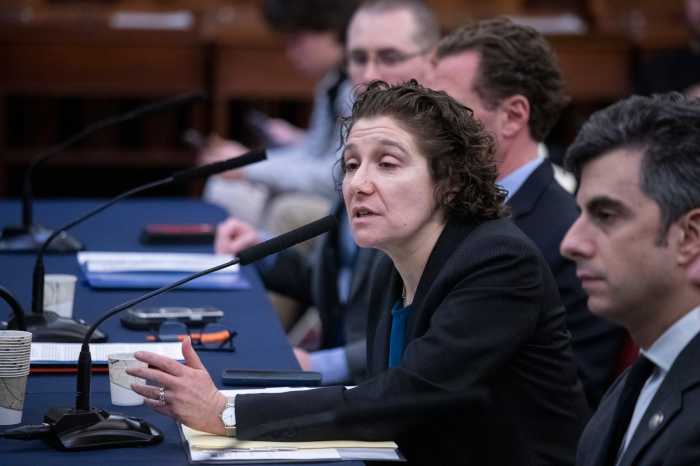 Outgoing Division of Social Companies Commissioner Molly Wasow Park testifies on the Metropolis Council listening to on Code Blue operations.Photograph John McCarten/NYC Council Media Unit
One other flashpoint of Tuesday’s listening to was the case of a person who was discharged from Elmhurst Hospital through the Code Blue interval and later died from publicity. The listening to additionally surfaced sharp disagreements over the town’s coverage on involuntary removals throughout excessive chilly, a observe officers described as a final resort, however which Council Members recommended could also be used too sparingly.
Nolberto Jimbo Niola, 52, initially from Ecuador, was discovered on a park bench in Queens with discharge papers from Elmhurst Hospital, in response to Speaker Menin, who stated his case was an instance of what must be mounted.
Hudson pressed NYC Well being + Hospitals Senior Vice President Dr. Ted Lengthy on how a person may find yourself discharged from a hospital throughout Code Blue, who, whereas not commenting on Niola’s case particularly, stated a person just isn’t obligated to take the town up on their sources if they “have the capacity to make their own decisions.”
“Our job and our mission in the hospital is to take care of you, take care of you medically, and offer you all of the resources and all the hard work that we’ve put into making sure those resources are the best they can be, meeting you where you are, including literally bringing the warmth to you,” Lengthy stated. “But patients don’t have to take us up on those resources if they again have the capacity to make their own decisions. It’s their choice how they want to interact with us.”
Park stated that in the newest Code Blue season, which started again in November, a discover was despatched to all the metropolis’s hospitals reminding them to not discharge sufferers with no plan, however famous that the town doesn’t have direct regulatory authority over hospital discharge choices. Park famous {that a} discover “with stronger language” was reissued on Jan. 26.
Metropolis officers testified that because the chilly streak started on Jan. 19, the town carried out 85 involuntary removals of individuals dwelling outside. Of these, 33 have been performed by the DSS by its outreach groups, whereas 52 have been carried out by the NYPD, sometimes when officers decided a person posed a hazard to themselves on account of publicity or psychological well being considerations.
Metropolis officers emphasised that involuntary removing is ruled by state psychological hygiene regulation and requires a dedication that an individual is mentally in poor health and at imminent threat of significant hurt — a normal they stated can’t be met solely by somebody being exterior in freezing temperatures.
Park responded that whereas the state of affairs was regarding, outreach groups are constrained by state regulation. She stated the person had beforehand refused providers and that involuntary removing requires a clinician’s dedication that an individual is unable to make sound choices and is in imminent hazard — standards she stated weren’t routinely met on this case.


