


Mayor Zohran Mamdani at Friday’s Interfaith Breakfast (left) and Archbishop Ronald Hicks at his set up Mass at St. Patrick’s Cathedral (proper). Mamdani stated Monday he appears ahead to working carefully with Hicks regardless of lacking the historic ceremony.
Images by Lloyd Mitchell and Dean Moses
Mayor Zohran Mamdani tried to dismiss criticism Monday about his no-show at Friday’s set up of Archbishop Ronald Hicks at St. Patrick’s Cathedral — stressing that he appeared ahead to assembly and dealing with the brand new chief of Catholics in Manhattan, the Bronx and Staten Island.
Hicks, a Chicago native, formally assumed management from Cardinal Timothy Dolan, whose resignation was accepted final yr upon reaching the necessary retirement age of 75, to develop into the eleventh chief of New York’s Archdiocese in a ceremony attended by lots of of Catholic trustworthy, clergy, and civic leaders.
Mamdani, who had hosted his first Interfaith Breakfast on the morning of Hicks’ set up, informed reporters on Monday, “I wasn’t able to make that event, but I do look forward to sitting down with the cardinal, and I’m so excited, frankly, at his leadership in this city.”
“We see so often, frankly, that New Yorkers do not actually turn to elected officials in moments of need. They are turning to their faith leaders,” he stated, including that he hopes to collaborate carefully with Hicks shifting ahead.
A spokesperson for the Archdiocese confirmed that Hicks and Mamdani haven’t but spoken however hope to take action “very soon.”
“The Archbishop was only installed this past Friday; he said in his homily that day that he looks forward to working with government (and business, labor, the arts, etc.) for the common good,” the spokesperson stated.
They famous that Cardinal Dolan had beforehand met with Mamdani each throughout his mayoral marketing campaign and after he took workplace.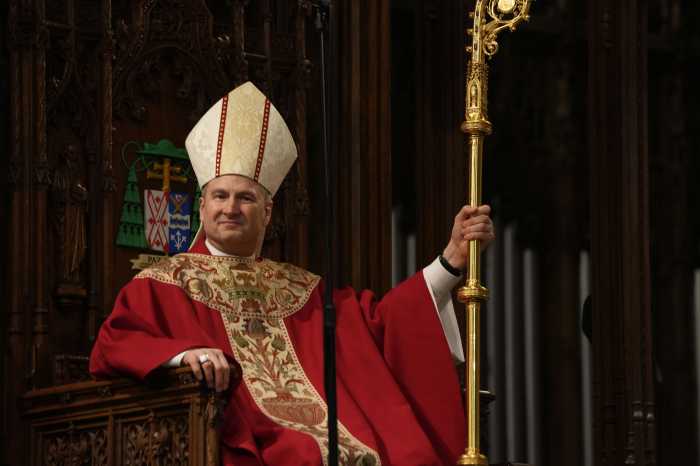 Archbishop Ronald Hicks sitting on altar with crozier moments after formally changing into the eleventh archbishop of the Archdiocese of New York at St. Patrick’s Cathedral on Feb. 6, 2026.Photograph by Dean Moses
Hicks informed reporters on Thursday forward of the Mass that he had not but met or spoken with Mamdani however expressed optimism about future collaboration.
“The new mayor and I have not had the opportunity to speak yet, and I’m sure that I will soon have that opportunity,” Hicks stated on Feb. 5. “I look forward to meeting him and getting to know him. What I’d like to do as the Archbishop here is understand that in politics, in government, there are going to be things that we disagree on. There are, but I’d also like to make sure we pay attention to what those things are that we can work together for the common good.”
Although Mamdani congratulated Hicks in a Friday put up on X, some Catholic leaders and critics noticed his absence as a break from custom.
William Donohue, president of the Catholic League for Spiritual and Civil Rights and a longtime critic of Mamdani, described it as “outrageous” and stated the mayor was signaling to Catholics that they’re “not welcome.”
“The mayor of New York City traditionally attends the installation of the new archbishop of New York, but Mamdani—who was invited—ghosted the event. The installation began a few hours after the Interfaith Breakfast at the New York Public Library; it is a short walk up Fifth Avenue to St. Patrick’s Cathedral. He could easily have been there. Instead, he attended to business as usual,” Donohue stated.
The Interfaith Breakfast, held on the New York Public Library earlier on Friday, drew about 400 representatives from throughout town’s religion communities, although no Catholic clergy spoke as a part of the primary program. Mamdani famous the gathering as a chance to attach with religion leaders throughout town.
The set up Mass for Hicks included a golden hammer to open the cathedral doorways, a procession of clerics, and the handoff of Cardinal Dolan’s crozier to Hicks.
In his first homily, Hicks emphasised gratitude and repair, calling for “a missionary church, not a country club,” and signaling a give attention to collaboration with authorities, enterprise, labor, the humanities, and different sectors “for the common good.”


